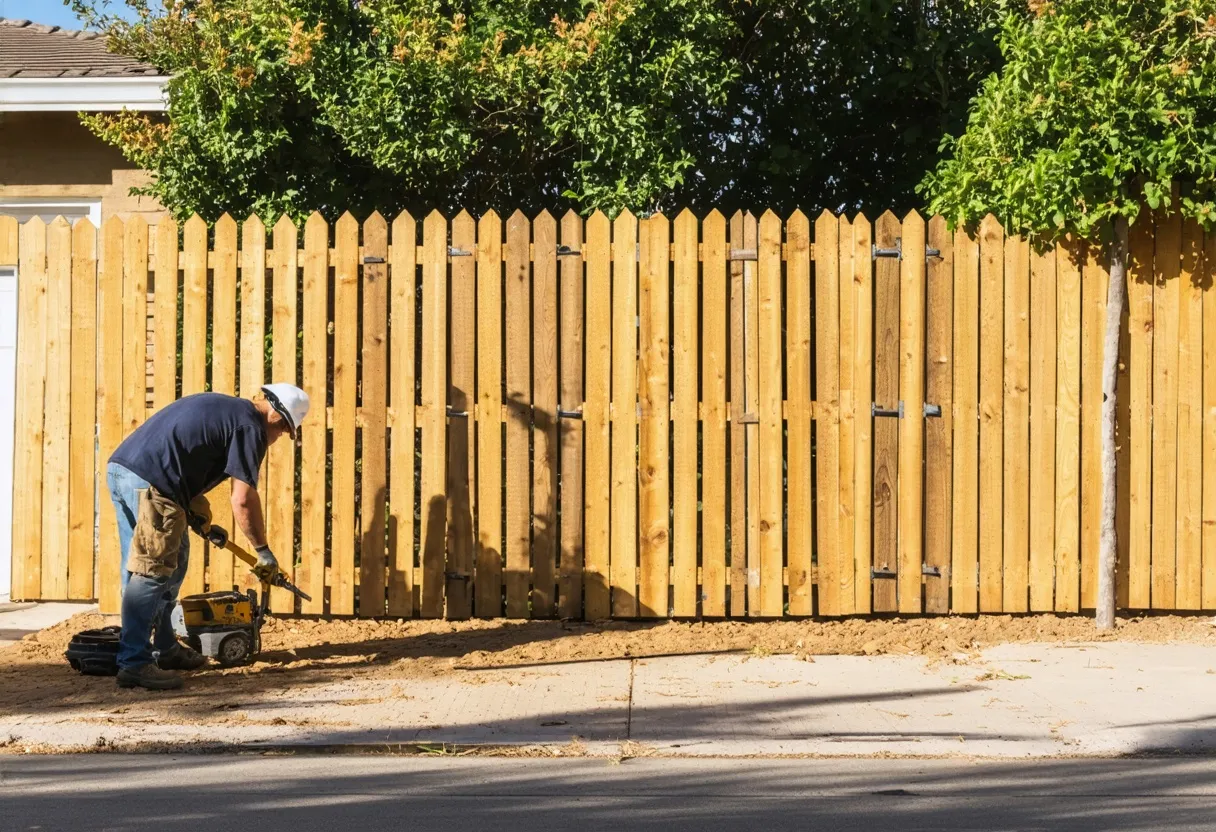
If you've priced out a wood fence in Chandler recently, you've probably run into the same two problems everywhere you look: nobody will give you a straight number until a salesperson is standing in your yard, and almost nobody mentions that Chandler has specific legal requirements for fencing around swimming pools that can void your permit — or worse, hold up your project — if they're missed. We built our wood fence service around fixing both of those gaps. You get real pricing information up front, and if your project touches a pool enclosure, you get a contractor who already knows the code instead of one who's learning it on your job site.
This page covers everything that goes into a wood fence project in Chandler, AZ — cedar and privacy fence options, how installation and repair actually work, what drives the final price, how our materials compare to vinyl, chain link, iron, aluminum, composite, and block wall, and what Chandler's pool-barrier rules mean for your build. Whether you're fencing a backyard off Tumbleweed Park, replacing storm-damaged panels near downtown, or enclosing a new pool, the goal here is to give you enough real information to make a good decision before you ever pick up the phone.
Wood Fence Installation in Chandler, AZ: What's Included
A wood fence installation isn't just "boards go up." Done right, it includes site layout and utility locates, post-hole digging and setting, rail and picket installation, gate hardware, and a final grading and cleanup pass. When you request an estimate, you should expect a written scope that spells out the wood species, board style (privacy, picket, board-on-board, shadowbox), fence height, post spacing, and gate count — not just a lump-sum number.
We install wood fencing for backyard privacy, front-yard curb appeal, side-yard dog runs, and pool enclosures, and we offer several board configurations:
- Privacy fencing — tight-spaced vertical boards, typically 6 feet tall, for full visual screening between neighboring yards.
- Board-on-board — overlapping boards on alternating sides of the rail, giving a finished look from both your yard and your neighbor's.
- Picket fencing — spaced boards, usually 3–4 feet tall, for front yards where you want definition without blocking the view.
- Shadowbox — alternating boards on each side with small gaps, which improves airflow through the fence line — a real advantage during Chandler's hottest months.
- Horizontal-slat wood fencing — a modern styling option using the same cedar or pine material in a horizontal orientation instead of vertical boards.
Cedar Fence Chandler: Why Wood Species Matters
Not all wood fencing is the same, and the species you choose affects how long it lasts and how much upkeep it needs. Cedar is the most requested option for a wood privacy fence in Chandler because it naturally resists insects and decay better than untreated pine, and it holds up well against long-term sun exposure without warping as quickly. Pressure-treated pine is a lower-cost alternative that performs well when it's properly sealed and maintained, but it typically needs more frequent staining to keep moisture and UV damage in check.
Arizona's climate is genuinely tough on exterior wood. Intense desert sun and occasional strong winds put real stress on fence lines over time — sun exposure dries and cracks boards, while wind gusts load up sagging or loose panels and can pop boards loose at the fastener. We factor that into how we build: correct fastener choice, sealed cut ends, and board spacing that allows for natural wood movement so your fence doesn't cup, twist, or split prematurely.
How Our Installation Process Works
We run every wood fence project through the same sequence so nothing gets missed:
- On-site estimate and measurement. We walk the fence line, confirm property boundaries where needed, note grade changes, and discuss board style, height, and gate placement.
- Written quote. You get an itemized quote covering materials, labor, gate hardware, and any permit work — before you commit to anything.
- Permitting (when required). Pool enclosures and certain fence heights require a permit through the Town of Chandler; we handle that paperwork as part of the project.
- Utility locates. We confirm underground utility lines before digging any post holes.
- Post setting. Posts are dug to the correct depth for the fence height and set in concrete for stability.
- Rail and picket installation. Rails go in first, then boards are hung, leveled, and spaced according to the agreed style.
- Gate installation. Gates are hung, hardware is installed and adjusted, and — for any pool-adjacent gate — self-latching hardware is fitted to meet code.
- Final walkthrough and cleanup. We walk the finished fence line with you, confirm everything matches the quote, and clear the site of scrap and packaging.
For a full breakdown of what drives the price at each of these steps, see our wood fence cost guide for Chandler.
Fence Repair Process: How We Diagnose and Fix Damage
Repair work follows a different process than new installation because the goal is to fix what's actually wrong without tearing out sections that are still sound. Our repair process typically runs like this:
- Inspection. We walk the full fence line, not just the section you called about, since damage in one area (a leaning post, for example) often explains problems elsewhere on the same run.
- Diagnosis. We identify whether the issue is at the post, the rail, or the boards, since a repair that only replaces boards won't hold if the post underneath has failed.
- Repair plan and quote. You get options — full section replacement versus targeted board or post repair — with pricing for each so you can choose based on budget and how much life is left in the rest of the fence.
- Repair work. Posts are reset or replaced first if needed, then rails, then boards, so the structure underneath is solid before cosmetic repairs go in.
- Match and finish. New boards are matched to existing wood tone and style as closely as possible, and any exposed cuts are sealed.
If your fence just needs a repair rather than a full replacement, our fence repair page covers turnaround times and repair-specific pricing in more detail.
Common Wood Fence Damage and What Causes It
Most of the repair calls we get in Chandler fall into a handful of categories:
- Rot — usually starts at the base of posts or the bottom edge of boards where moisture sits longest, particularly on older fences without sealed end cuts.
- Warping and cupping — boards that dry unevenly under sustained sun exposure can bow or twist, especially lower-grade lumber that wasn't properly kiln-dried.
- Sagging — gates and long unsupported spans sag over time as hardware loosens and posts shift; wind loading accelerates this on taller privacy sections.
- Broken or split boards — impact damage, wind-driven debris, or simple age-related brittleness can crack individual pickets without affecting the rest of the fence.
- Loose or leaning posts — the most structurally serious issue, since everything attached to a failing post will eventually fail with it.
- Rusted hardware — hinges, latches, and fasteners can corrode over years of exposure, leading to gates that stick, sag, or won't latch securely — a real problem if that gate is part of a pool enclosure.
Catching these early is almost always cheaper than waiting. A single split board is a quick fix; a rotted post left unaddressed can take out an entire section of fence in the next windstorm.
Comparing Fence Materials: Wood vs. Vinyl, Chain Link, Iron, Aluminum, Composite, and Block Wall
Wood is our specialty, but it isn't the only material we install, and it isn't always the right answer for every yard. Here's how it stacks up:
- Wood (cedar/pine) — the best balance of cost and classic curb appeal, fully customizable in height, style, and stain color; needs periodic sealing/staining to maximize lifespan in Arizona's sun.
- Vinyl — higher upfront cost than wood, doesn't rot or need staining, holds color well, but can become brittle over time under repeated extreme heat.
- Chain link — the most budget-friendly option, ideal for side yards, dog runs, or utility fencing where privacy isn't the goal; can be fitted with privacy slats.
- Wrought iron / ornamental metal — premium look, excellent security and visibility, common for front-yard and pool-adjacent fencing where you want a barrier without blocking sightlines.
- Aluminum — similar look to iron at a lighter weight and lower cost, doesn't rust, and is a popular pool-fence choice because it meets barrier height requirements without blocking the view of the water.
- Composite — engineered to look like wood grain without the staining maintenance; higher material cost but very low upkeep over its lifespan.
- Block wall — the most permanent and highest-cost option, common along property perimeters and in HOA communities that require masonry; also frequently used to satisfy pool-barrier height requirements.
If privacy, natural appearance, and cost-effectiveness top your list, wood wins. If you want a pool-adjacent barrier that keeps sightlines open, aluminum or iron is often the better call — and we install all of the above, so we'll tell you honestly which one fits your yard instead of steering you toward whatever we happen to stock.
Chandler Pool-Fencing Code: What You Need to Know Before You Build
If your wood fence project involves a pool — either enclosing a new pool or replacing a fence that currently serves as the pool barrier — this is the section to read carefully. Chandler requires pool barriers to be 6 to 7 feet tall and constructed of masonry or another decorative barrier material, with self-latching gates, and a permit is required for the work. This isn't optional and it isn't something a contractor can wave off after the fact.
A few practical implications for homeowners:
- A standard 6-foot wood privacy fence can often be used as part of a pool enclosure, but the gate hardware and permit paperwork still have to meet code — you can't just hang a standard gate latch and call it done.
- Because a decorative masonry or barrier-grade material is required for pool enclosures, some homeowners pair a wood fence on the non-pool sides of the yard with a block wall or masonry section along the pool side to satisfy the requirement.
- Permits take time to process, so pool-adjacent fence work should be scheduled with that in mind rather than treated as a same-week project.
- If you're buying a home in Chandler with an existing pool fence, it's worth having it checked against current code — older gate hardware in particular is a common point of non-compliance.
We handle the permit application and build to the code requirement as a standard part of any pool-adjacent fencing project, so you're not left trying to interpret municipal requirements on your own.
Custom Fence Styles We Build
Beyond standard wood privacy and picket fencing, we also build a range of specialty and custom styles for Chandler properties with larger lots or specific functional needs:
- Horizontal wood fencing — a contemporary alternative to vertical board styles, popular for front-yard and courtyard applications.
- Farm and ranch-style fencing — post-and-rail construction for larger properties, livestock containment, or a rustic aesthetic.
- Wire and cable fencing — low-profile options that define property lines or contain pets without blocking views, often paired with wood posts for a cleaner look.
These styles are quoted the same way as standard wood fencing — an on-site walk, a written estimate, and no pressure to upgrade beyond what your property actually needs.
Commercial and Security Fencing
While this page is focused on wood fencing for residential properties, we also handle commercial and security fencing for Chandler businesses, including:
- Warehouse and industrial perimeter fencing — typically chain link or ornamental steel, sized for large lots and built for durability under continuous use.
- Anti-climb security fencing — tighter mesh patterns and increased height for facilities that need a higher deterrent standard than standard chain link provides.
- Access-controlled gates — sliding or swing gates with commercial-grade hardware for controlled vehicle and pedestrian entry.
If you're a property manager or business owner evaluating options, we're happy to provide a separate commercial estimate — the process mirrors residential work but scopes for higher-traffic use and commercial-grade materials.
What Affects the Cost of a Wood Fence in Chandler
Every quote we give is itemized, but the main variables that move the number are:
- Linear footage — the total length of fence line is the single biggest cost driver.
- Wood species and grade — cedar costs more than pressure-treated pine but needs less frequent maintenance.
- Fence height and style — taller privacy fencing and board-on-board construction use more material than standard picket fencing.
- Number and type of gates — walk gates are simpler than double-drive gates, and pool-compliant self-latching gate hardware adds a line item.
- Terrain and access — sloped yards, tight side-yard access, or existing landscaping near the fence line can add labor time.
- Removal of an existing fence — tear-out and haul-away of an old fence is typically quoted separately from new installation.
- Permit requirements — pool-adjacent projects include permit application time as part of the scope.
For a detailed, line-item look at how these factors translate into real numbers, see our Chandler fence cost breakdown. We'd rather you go into your estimate call already understanding the pricing logic than have it feel like a black box.
Free Estimates, No Obligation
Every estimate we provide is free and comes with no obligation to move forward. We measure your fence line, walk you through style and material options, and leave you with a written quote you can take your time reviewing — no same-day-signature pressure, no inflated "today only" pricing tactics. If a pool barrier or other code requirement applies to your project, we'll flag it during the estimate, not after materials are already on order.
Get Your Free Quote
No obligation, no pressure — just a clear picture of cost and compliance.
More fencing services
Ready For A Fence That Fits Chandler?
Get a clear, upfront quote — including pool-code details if they apply to your property.