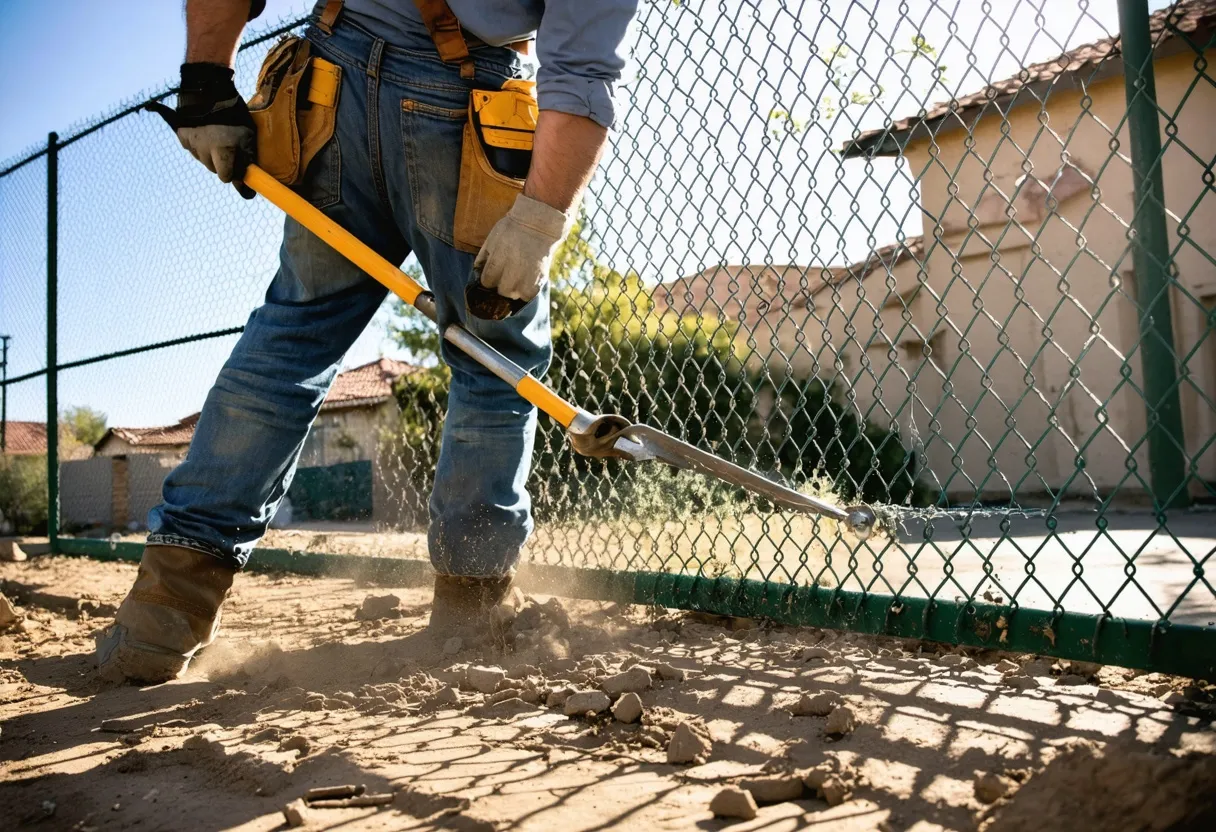
If you've searched for chain link fence Chandler installation or repair, you've probably noticed two things missing from most of the results: nobody tells you what it actually costs, and nobody mentions that Chandler has a mandatory pool-fencing code that can turn a simple backyard fence project into a permit headache if you don't plan for it. We built this page to fix both problems. Below you'll find straightforward pricing guidance, a full breakdown of how galvanized chain link fencing holds up against Chandler's climate, and a plain-English explanation of what the city actually requires around a pool. No sales pitch, no vague "call for a quote" dead end — just what you need to make a good decision.
Why Chandler Homeowners Choose Chain Link Fencing
Chain link remains one of the most requested fence types in Chandler, AZ, and for good reason. It's the fastest fence to install, the least expensive per linear foot, and it requires almost no upkeep compared to wood or wrought iron. For pool enclosures, side yards, dog runs, RV pads, and commercial perimeters, galvanized chain link gives you a durable barrier without the cost of a full privacy fence. It also holds up well against wind — chain link's open weave lets air pass through instead of catching it like a solid panel does, which matters when Chandler sees occasional strong desert wind gusts throughout the year (F6).
That said, chain link isn't the right fit for every application, and part of doing this job well is telling you honestly when a different material makes more sense — whether that's for privacy, resale value, or pool-code compliance. We cover those trade-offs in detail further down this page.
What Our Chain Link Fence Installation Includes
A proper chain link fence installation in Chandler AZ is more than just unrolling mesh and driving posts. Here's what a complete job covers:
- Site evaluation and layout — walking the property line, marking corners, and identifying gate locations before anything is dug.
- Utility locates — calling in a locate request so buried lines are flagged before post holes go in.
- Post setting — terminal (end, corner, and gate) posts set in concrete footings, spaced correctly to support line posts.
- Line post installation — evenly spaced posts that carry the top rail and mesh along straight runs.
- Top rail and tension wire — the framework that keeps the fence rigid and prevents sagging over time.
- Galvanized mesh fabric installation — stretched and tensioned properly so it doesn't bow or loosen.
- Gate hanging and hardware — including latch hardware, and self-latching mechanisms where the fence encloses a pool.
- Finish work — tension bands, caps, tie wires, and a final walkthrough with the homeowner.
Every one of these steps affects how long the fence lasts and how it looks five years from now, not just on installation day. Corners cut on post depth or fabric tension are the number-one reason we get called out for early repairs.
Galvanized Chain Link: What "Galvanized" Actually Means for Durability
Galvanized chain link fence is steel wire coated in zinc, which protects the underlying metal from rust and corrosion. In Chandler's climate — long stretches of intense desert sun combined with occasional strong winds (F6) — the coating matters more than most homeowners realize. UV exposure and heat cycling can degrade lower-quality coatings faster, which is why we spec galvanized fabric as the standard rather than an upgrade. A few things that separate a fence that lasts from one that doesn't:
- Coating quality — hot-dip galvanized coatings generally outlast electroplated (lighter) coatings under sustained sun exposure.
- Wire gauge — thicker gauge wire resists sagging and impact damage better, especially on pool enclosures and dog runs where the fence takes more abuse.
- Mesh (diamond) size — smaller diamond spacing adds rigidity and is often required or preferred for pool barriers.
- Post spacing and footing depth — undersized footings are the leading cause of leaning posts and sagging fence lines we see on repair calls.
We're happy to walk you through gauge and coating options during your estimate — what's right for a side-yard dog run is different from what's right for a pool enclosure or a commercial perimeter.
Comparing Fence Materials: Chain Link vs. Everything Else
Chain link is our specialty, but it's not automatically the right answer for every project. Here's how it stacks up against the other materials we install and repair around Chandler:
Wood Fencing
Wood offers full privacy and a warmer look, but it requires the most maintenance of any material on this list. In a desert climate, wood is prone to drying, splitting, and warping from sun exposure, and rot or insect damage can still develop at ground contact points. It's a solid choice for backyard privacy where budget allows for periodic staining and board replacement.
Vinyl Fencing
Vinyl doesn't rust, rot, or need painting, and it holds color well under sun exposure. Upfront cost is higher than chain link, and panels can crack under strong impact, but for homeowners who want a clean, low-maintenance privacy fence, vinyl is one of the most popular upgrades we quote.
Wrought Iron / Ornamental Iron
Iron fencing is the premium option for curb appeal — it doesn't block views, works well for front yards, and pairs naturally with pool areas where you want a barrier without losing sightlines to the water. It costs more than chain link and requires occasional rust-prevention maintenance on cut edges and welds.
Composite Fencing
Composite blends the low-maintenance benefits of vinyl with a wood-grain look. It resists fading and warping better than natural wood and doesn't need staining, but it carries a higher material cost than either wood or chain link.
Aluminum Fencing
Aluminum is a lighter-weight alternative to iron with similar open-sightline styling. It won't rust and holds up well in sun and wind, making it a common pick for pool enclosures where a decorative, code-compliant look is wanted without iron's price tag or maintenance.
Block Wall
Masonry block wall is the most permanent option and doubles as a sound and privacy barrier between properties. It's also one of the accepted pool-barrier types under Chandler's code (more on that below). Block costs more and takes longer to build than any fence material, but it requires essentially no maintenance once finished.
Chain Link
Chain link wins on cost-per-foot, install speed, and durability against wind. It's the right call for side yards, pool enclosures on a budget, dog containment, RV and storage areas, and any application where security or containment matters more than privacy. If privacy is a priority, we can add privacy slats to chain link as a middle-ground option between open mesh and a solid fence.
Chandler's Pool-Fencing Code: What You Need to Know
This is the part most fencing pages skip entirely, and it's often the most important information on the page if you're fencing a pool area. Chandler requires a dedicated pool barrier that is separate from a general perimeter fence, and the requirements are specific:
- The barrier must be between 6 and 7 feet tall, and it must be masonry or a decorative barrier meeting the city's enclosure standards (F1).
- Gates within the pool barrier must be self-latching (F1).
- A permit is required before installation of a pool barrier (F1).
We design and install chain link, iron, and aluminum pool enclosures that are built to meet this standard from the start, and we handle the permit paperwork so you're not stuck decoding city code on your own. This is where a lot of DIY and out-of-town contractor jobs go wrong — a fence that looks fine can still fail inspection if the gate hardware, height, or barrier type doesn't meet the requirement. If you're not sure whether your existing fence qualifies as a compliant pool barrier, we'll evaluate it as part of your free estimate and tell you plainly whether it passes or needs modification.
Chain Link Fence Repair: Our Process
Not every fence problem needs a full replacement. Our chain link fence repair process in Chandler is built around fixing what's actually broken rather than upselling a new install. Here's how a repair visit typically goes:
- Diagnosis — we inspect the full fence line, not just the section you called about, since one weak point often signals a related issue nearby (a leaning post can be why the gate won't latch, for example).
- Assessment and options — we tell you honestly whether the damage is a spot repair, a section replacement, or a sign the fence has reached the end of its useful life.
- Sourcing matching materials — matching mesh gauge, coating, and post size so a repaired section doesn't stand out or create a weak point.
- Repair execution — resetting posts in fresh concrete, re-stretching sagging fabric, replacing damaged mesh panels, or rebuilding gate hardware.
- Final tensioning and inspection — checking that the repaired section matches the tension and alignment of the rest of the fence line.
For pool enclosures specifically, we also confirm the repaired section still meets the self-latching gate requirement (F1) before we call the job done — a repair that leaves a pool gate out of compliance isn't a finished repair in our book.
Common Chain Link Fence Damage We Repair
- Rust and corrosion — usually starting at cut edges, welds, or where the galvanized coating has worn thin over years of sun exposure.
- Sagging fabric — mesh that's lost tension over time, often from age or a section that was under-tensioned during the original install.
- Leaning or heaving posts — caused by undersized or shallow footings that can't hold the post steady under wind load or ground movement.
- Bent or broken rails and posts — from vehicle impact, falling branches, or wind-driven debris during a strong gust event.
- Warping — most common in wood and vinyl sections adjoining a chain link run, from prolonged sun exposure.
- Broken or damaged boards/panels — where a property has mixed materials, such as a chain link perimeter with a wood privacy section.
- Gate hardware failure — latches, hinges, and self-latching mechanisms that wear out with regular use, which is a compliance issue as well as a convenience one on pool enclosures (F1).
Because ground conditions and digging difficulty vary by property, post-setting depth and footing size are something we assess on site rather than guess at from a phone estimate — it's one of the most common reasons a "quick repair" ends up needing a slightly different approach than expected.
Commercial and Security Fencing
Beyond residential yards, chain link is the backbone of most commercial and industrial security fencing we install around Chandler. Typical commercial applications include:
- Warehouse and distribution yard perimeters — tall galvanized chain link, often with barbed wire or razor wire top guards for restricted-access sites.
- Industrial site fencing — durable enclosures around equipment yards, storage areas, and construction sites.
- Anti-climb fencing — tighter mesh spacing and taller heights designed to deter unauthorized access at commercial and utility sites.
- Fleet and equipment lot security — chain link paired with cantilever slide gates for vehicle access control.
Commercial jobs are quoted based on linear footage, height, gate automation needs, and any added security features like top guards or anti-climb mesh. We handle both new commercial installs and repair/maintenance contracts for property managers who need a fence line kept secure year-round.
Custom Fence Styles We Install
Not every project fits the standard chain-link-or-privacy-fence mold. We also install several custom and specialty styles:
- Cable railing and cable fencing — sleek, minimal-sightline fencing often used for view fencing or modern-style yards.
- Wire fencing — lighter-duty welded or woven wire, useful for garden enclosures and light containment.
- Farm and ranch fencing — field fence and pipe-and-wire style fencing for larger properties, livestock containment, or acreage perimeters.
- Horizontal-style fencing — a modern aesthetic typically built in wood or composite, popular for front-yard and courtyard applications where curb appeal matters most.
If you're mixing styles — say, a horizontal wood front-yard fence with a chain link side yard for a dog run — we can quote the full property as one coordinated project.
What Drives Chain Link Fence Cost in Chandler
We believe in giving you real numbers before you commit to a call, not after. For a detailed breakdown of current pricing ranges by height, gauge, and gate configuration, visit our chain link fence cost guide for Chandler. In general, the biggest cost factors are:
- Linear footage — the total length of fence line, which is the largest single driver of total project cost.
- Height — taller fencing, especially in the 6-7 foot range required for pool barriers (F1), uses more material and labor per foot.
- Gauge and coating — heavier gauge, higher-quality galvanized fabric costs more upfront but lasts longer under sun and wind exposure.
- Gates — the number of gates, gate width, and self-latching hardware for pool compliance all add to the quote.
- Terrain and access — sloped yards, tight side-yard access, or obstacles near the fence line can add labor time.
- Permit requirements — pool barrier installations require a permit (F1), which we factor into project timelines and paperwork.
- Removal of an old fence — tear-out and haul-away of an existing fence adds to the scope if you're replacing rather than building new.
We provide itemized, written estimates so you can see exactly what you're paying for — no lump-sum guesswork.
Free Estimates, No Obligation
Every project starts with a free, no-obligation estimate. We walk your property, measure the fence line, evaluate any pool-barrier compliance needs (F1), and give you a written quote on the spot — not a follow-up call three days later. If you're comparing quotes from other Chandler fence companies, we're glad to be the one you compare everyone else against; we'd rather earn the job on a clear, itemized price than a lowball number that grows once work starts.
We also stand behind the work once it's done. Details on coverage and what's included are on our fence installation warranty page, and if you need to spread out the cost of a larger project, our fence financing options for Chandler homeowners outline the payment plans available.
Why Work With a Local Chandler Fence Company
Fencing in the Valley isn't the same as fencing in a milder climate. A crew that installs fence in Chandler regularly understands how intense desert sun and periodic strong wind (F6) affect material choice, post footing depth, and gate hardware over time — details that matter more here than in a lot of other markets. We also know the local permitting process for pool barriers (F1), which saves you time versus a contractor who's never pulled a Chandler permit before. And because we work in this market every week, we can typically schedule estimates and installs faster than a company that has to route a crew in from out of town.
What Chandler Customers Tell Us Matters Most
Across the estimates and jobs we run in Chandler, the same priorities come up again and again: a clear price before work starts, a fence that's actually built to meet pool-barrier requirements rather than "close enough," and a crew that shows up when scheduled. That's the standard we hold every job to, and it's why transparent, itemized pricing and code compliance are the two things we lead with on this page rather than bury at the bottom.
Get Your Free Quote
No obligation, no pressure — just a clear picture of cost and compliance.
More fencing services
Ready For A Fence That Fits Chandler?
Get a clear, upfront quote — including pool-code details if they apply to your property.