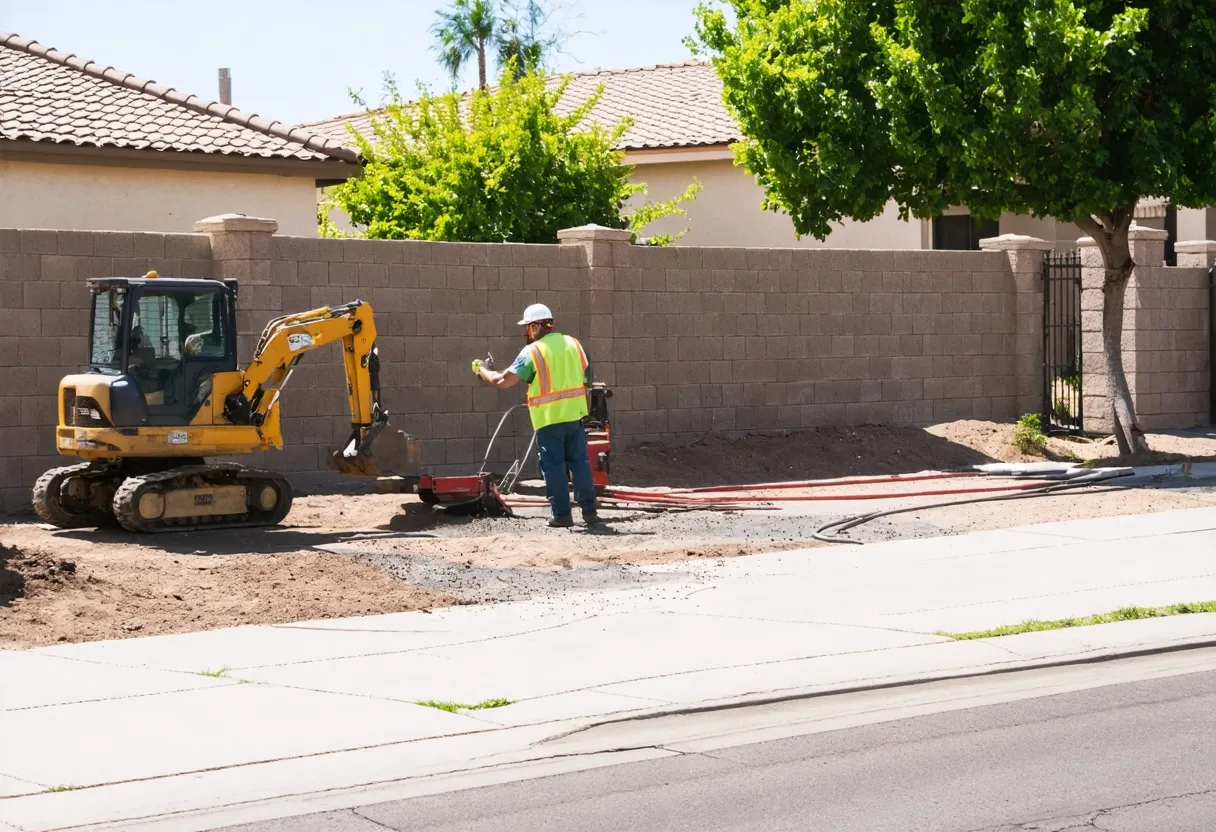
Fencing Chandler Pros builds and repairs commercial fencing for warehouses, distribution centers, retail plazas, self-storage facilities, and industrial yards throughout Chandler, AZ. Two things set this page apart from every other commercial fencing result you'll find for this market: we quote real, itemized pricing up front instead of making you call for a "custom quote," and we handle Chandler's mandatory pool-fencing code correctly the first time — a compliance detail almost every competitor page in this market skips entirely, even though it trips up property managers, HOAs, and multi-family developments constantly. Whether you need anti-climb perimeter security around an industrial site, a chain link upgrade for a warehouse yard, or a code-compliant barrier around a community pool amenity, this page walks through exactly what's involved, what it costs, and how to get it done without surprises.
What Commercial and Industrial Fencing Covers in Chandler
Commercial fencing is a different job than a residential backyard fence, even when some of the materials overlap. Chandler's commercial corridors — along the Loop 202, the Price Road tech corridor, and the industrial pockets near the airpark — have their own set of priorities: perimeter security, vehicle access control, wind load on large uninterrupted runs, and code compliance for any site with a pool, retention basin, or public-facing amenity. A commercial fencing contractor working in this market needs to account for all of it, not just install panels.
Typical commercial and industrial fencing projects we handle in Chandler include:
- Warehouse and distribution yard fencing — tall chain link or welded wire perimeters, often paired with cantilever slide gates for truck access
- Industrial site security fencing — anti-climb mesh, barbed wire top guards, and reinforced posts around equipment yards and outdoor storage
- Retail and office park fencing — decorative iron, vinyl, or block wall screening that meets a shopping center's aesthetic standards
- Multi-family and HOA pool enclosures — code-required barriers around community pools and spas
- Self-storage facility fencing — full-perimeter chain link with electronic gate access integration
- Construction site temporary fencing and permanent replacement fencing once a build is complete
Each of these has a different failure point if it's done wrong — a warehouse fence that's too short invites theft, a retail property fence that ignores HOA architectural standards gets rejected, and a pool enclosure that doesn't meet Chandler's code can hold up a certificate of occupancy. We scope every commercial job against its actual use case, not a one-size template.
Anti-Climb Security Fencing for High-Risk Sites
For sites where deterrence matters most — equipment yards, utility substations, cargo staging areas, and after-hours industrial properties — standard chain link isn't enough. Anti-climb security fencing in Chandler typically means tighter mesh spacing (so fingers and boot toes can't get purchase), taller overall height, outward-angled top rails or barbed wire arms, and heavier gauge fabric than a standard commercial run. We also pay close attention to bottom-of-fence gaps; a fence that's climb-resistant at the top but has a six-inch gap at grade on uneven desert soil is still an easy entry point. On sloped or graded commercial lots, we rake or step the fence line so there's no crawl-under gap anywhere along the perimeter.
Gate hardware matters as much as the fabric on a security fence. We spec commercial-grade panic hardware, keyed access, or electronic entry depending on how the site is staffed, and we make sure gate posts are set deep enough and braced well enough that the gate itself doesn't become the weak point in an otherwise secure perimeter.
Fencing Materials: What Works Best for Which Application
Chandler's climate — long stretches of intense desert sun, occasional but real monsoon winds, and wide day-to-night temperature swings — affects how every fencing material performs here differently than it would in a milder climate. Here's how the major options stack up for both commercial and residential use in this market.
Chain Link
Still the workhorse of commercial and industrial fencing in Chandler. Galvanized or vinyl-coated chain link handles wind load well because it's an open weave rather than a solid panel, which matters on exposed warehouse and yard perimeters. Commercial-gauge chain link with heavier posts is what we spec for anything security-focused; lighter residential-gauge chain link is fine for a back lot line but undersized for a business perimeter.
Wrought Iron and Ornamental Steel
The go-to choice where a commercial property wants security without looking like a warehouse yard — retail frontages, office parks, and HOA common areas. Iron holds up to Chandler's sun without warping or degrading the way some wood products do, though it needs a quality powder coat or paint finish to resist rust, especially where irrigation or monsoon runoff keeps a base rail damp longer than the rest of the fence.
Aluminum
A lighter-weight, lower-maintenance alternative to iron for pool enclosures and decorative perimeters. Aluminum won't rust, which makes it a strong fit for pool-adjacent fencing where chlorine splash and irrigation overspray are constant. It's not the right choice for high-security anti-climb applications since it can be pried or bent more easily than steel, but for code-compliant pool barriers and HOA aesthetics it performs well.
Vinyl
Popular for screening fences around commercial dumpster corrals, equipment pads, and property lines where you want a solid sightline block. Vinyl doesn't rot and resists Arizona's UV exposure better than it used to now that most manufacturers use UV-stabilized resin, but cheaper vinyl can still go brittle and crack after repeated summers of intense sun — worth asking about the product grade before you buy.
Wood
Less common on commercial sites but still used for screening and some retail-adjacent applications where a natural look is wanted. Wood is the material most vulnerable to Chandler's climate: sun exposure dries and cracks boards, and the swing between hot days and cooler nights accelerates warping. If wood is the right look for your property, cedar or a properly sealed pine with a maintenance plan will outlast an unsealed board fence by years.
Composite
A middle ground between wood's look and vinyl's low maintenance. Composite resists rot and insect damage and handles sun exposure better than raw wood, though it costs more up front. For commercial properties that want a wood aesthetic without an ongoing repair contract, composite is often the better long-term math.
Block Wall
Common on Chandler property lines, especially where a commercial site backs up to residential or where sound and dust screening matter. Block walls are the most durable option against wind and impact but are also the most expensive and the slowest to install. We coordinate block wall work for property line and pool-enclosure projects where a masonry barrier is required or preferred over a fabricated fence.
Custom and Specialty Fence Styles
Beyond standard commercial fencing, we also install a range of specialty styles for properties that want a specific look or function:
- Cable railing fencing — horizontal steel cable runs, popular for modern commercial frontages and view-preserving property lines
- Welded wire fencing — a step up from chain link for a cleaner, more architectural look while keeping an open sightline
- Farm and ranch-style fencing — for Chandler's remaining agricultural and equestrian lots, typically pipe or wood rail construction built for livestock containment rather than security
- Horizontal-style fencing — wood or composite boards run horizontally instead of vertically, a look increasingly requested for modern retail and mixed-use properties
These styles come up most often on mixed-use developments and properties where the fence is part of the property's street-facing design, not just a functional barrier.
Our Fence Repair Process
Not every fencing problem needs a full replacement. Our repair process is built to fix what's actually broken and leave the rest of the fence alone:
- On-site inspection. We walk the full fence line, not just the section you called about — damage in one area often signals a developing problem elsewhere, especially post shifting or rot that hasn't reached the surface yet.
- Diagnosis and scope. We identify the root cause, not just the symptom. A sagging gate might be a hinge problem or it might be a settling post — those get fixed differently.
- Written repair estimate. You get a clear, itemized quote before any work starts, broken out by material and labor so you can see exactly what you're paying for.
- Material matching or upgrade. Where possible we match existing fencing so a repair doesn't look patched. Where the original material or gauge was undersized for the application, we'll flag that and offer an upgrade option rather than repeating the same failure.
- Repair execution. Post resets, panel or board replacement, hardware swaps, rust treatment, and re-tensioning of chain link fabric are all handled in the same visit for most standard repairs.
- Final walkthrough. We check gate operation, latch function, and overall fence line alignment before calling the job complete.
Common Fence Damage and Issues We See in Chandler
Chandler's desert climate is hard on fencing in specific, predictable ways. Knowing what to look for helps you catch a small repair before it becomes a full replacement.
- Wood rot and cracking — less about moisture damage (as it would be in a wetter climate) and more about UV-driven drying and splitting, plus rot at post bases where irrigation or monsoon runoff pools against the wood.
- Rust on iron, steel, and chain link hardware — accelerated wherever sprinklers, drip irrigation, or pool splash keep a section of fence damp between long dry stretches; galvanized coatings and quality paint finishes slow this significantly.
- Warping — vinyl and lower-grade wood can warp under sustained direct sun exposure, especially on west- and south-facing fence lines that take the most intense afternoon heat.
- Sagging gates and fence sections — often caused by posts that were set too shallow or without adequate concrete footing for our soil conditions, made worse over time by wind load during monsoon season.
- Broken or missing boards and panels — from wind events, impact, or simple UV fatigue in older wood fencing that was never sealed or resealed.
- Leaning or shifted posts — Chandler's expansive soils can shift slightly with seasonal moisture changes, which over years can throw a fence line out of alignment even without a single storm event.
Strong, occasional monsoon winds are a real factor for any commercial fence line in this area — it's one of the reasons we don't undersize posts or footings just to hit a lower bid, since a fence that comes down in a wind event costs more to fix than it would have cost to build correctly the first time.
Chandler Pool Fence Code Compliance for Commercial and Multi-Family Properties
If your commercial property includes a pool or spa amenity — common on multi-family, HOA, and hospitality sites — Chandler's pool barrier code isn't optional, and getting it wrong can delay occupancy or trigger a re-inspection. The core requirements we build to:
- A barrier height of 6 to 7 feet, using masonry or another approved decorative barrier material
- Self-latching gates on every point of pool access
- A permit is required before the barrier is installed
We handle the permit process as part of the job rather than leaving you to navigate the city's requirements on your own, and we make sure the barrier material and height are documented correctly before the inspection is scheduled. For property managers and developers juggling a dozen other items on a project punch list, this is one of the easiest things to get wrong by assuming a standard fence height or a standard latch is good enough — it isn't, and inspectors check for the specifics.
This is also one of the areas where we see the most competitor pages in this market say nothing at all, which is a real gap given how often pool-adjacent commercial and multi-family projects come up in a city with Chandler's density of apartment and HOA communities.
What Affects Commercial Fencing Cost in Chandler
Commercial fencing pricing varies more than residential pricing because the variables are bigger — linear footage alone can swing a bid by tens of thousands of dollars. The main cost drivers we walk every commercial client through:
- Total linear footage and height — the two biggest line items on any bid, and the reason a warehouse perimeter costs differently than a retail frontage of the same material
- Material and gauge — commercial-grade chain link, iron, or vinyl costs more than residential-grade product but lasts longer under commercial use and Chandler's sun exposure
- Gate type and quantity — a manual walk gate is inexpensive; a cantilever slide gate with electronic access control is a significant line item on its own
- Site conditions — rocky or caliche soil common in parts of Chandler can slow post-hole digging and add labor time compared to easier ground
- Permit and code requirements — pool barrier compliance, HOA architectural review, or municipal permitting add time and sometimes material requirements beyond a basic install
- Removal and disposal of existing fencing — tear-out of an old fence line adds labor that's easy to leave out of a lowball quote
We break every commercial estimate down by these categories instead of handing over a single lump-sum number, so you can see exactly where your budget is going. For a detailed breakdown of typical per-foot and per-project pricing across materials, see our Chandler fence cost guide. If a project needs to be phased or spread across a budget cycle, we also offer financing options for larger fencing projects so a full-property security upgrade doesn't have to happen all at once.
Free, No-Obligation Estimates
Every estimate we provide is free, written, and comes with no obligation to move forward. For commercial properties, that estimate includes a full site walk, material recommendations for your specific application, and a line-item cost breakdown — not a rough number given over the phone. We'd rather you compare our itemized quote against another contractor's quote directly than ask you to just trust a total figure.
Our Installation Process
- Site assessment and measurement. We walk the full property line or yard perimeter, note grade changes, existing structures, and gate access points.
- Material and design consultation. Based on the site's use — security, screening, pool compliance, or aesthetics — we recommend the material and specification that fits, not the most expensive option available.
- Written quote and permit review. You receive an itemized estimate, and we flag any permitting requirements (including pool barrier permits) up front.
- Scheduling. We give you a realistic installation window rather than a vague "we'll call you" timeline.
- Installation. Post setting, footings, fabric or panel installation, and gate hardware are completed by our crew, with attention to Chandler-specific factors like soil conditions and wind bracing.
- Final inspection and walkthrough. We confirm gate operation, latch compliance where applicable, and overall fit and finish with you before the job is considered done.
Why Choose a Local Chandler Fencing Contractor
A contractor based near Chandler brings two things an out-of-area or national chain can't: familiarity with the city's permitting and pool code process, and enough local job history to know how this specific soil, sun, and wind pattern treats different materials over time. We work across the Chandler area, from properties near downtown Chandler and Dr. A.J. Chandler Park to commercial sites near Chandler Fashion Center and the retail corridors around it, out to properties near Tumbleweed Park and the areas bordering Mesa. That range of work across the city means we've seen how fencing performs on different lot types and soil conditions across Chandler, not just in one neighborhood.
Local presence also matters for response time. When a commercial gate fails or a storm knocks down a section of perimeter fencing, a contractor who's already working in Chandler day to day can get to your site faster than one dispatching from across the Valley.
Warranty and Long-Term Protection
Commercial fencing is a long-term investment, and we stand behind our installation work accordingly. Full details on coverage terms, what's included, and how to file a claim if something goes wrong are on our fence warranty page. We'd rather you read the actual terms before you sign a contract than find out what's covered after something breaks.
A Track Record Built on Doing the Job Right
Most of our commercial work in Chandler comes from property managers and business owners who found us through a referral from another property they manage, or from a previous job we did on the same site. We're glad to connect you with a recent commercial client in your area of Chandler if you'd like to see finished work and ask about their experience directly — that's a better way to evaluate a fencing contractor than reading quotes on a website, ours included.
Get Your Free Quote
No obligation, no pressure — just a clear picture of cost and compliance.
More fencing services
Ready For A Fence That Fits Chandler?
Get a clear, upfront quote — including pool-code details if they apply to your property.